On this page I present selected research projects and publications in more detail. Below you will also find a list of my academic talks.
Digital Humanities Lab (DH Lab)
The DH Lab is an interdisciplinary networking platform in the field of Digital Humanities at the University of Hamburg (UHH), Germany. The open workshop zone in the Humanities Library is a place for hands-on workshops and offers staff and students space for discussions, readings and collaborative work.
Since 2025 I am head of the DH Lab at UHH.
Intertextor
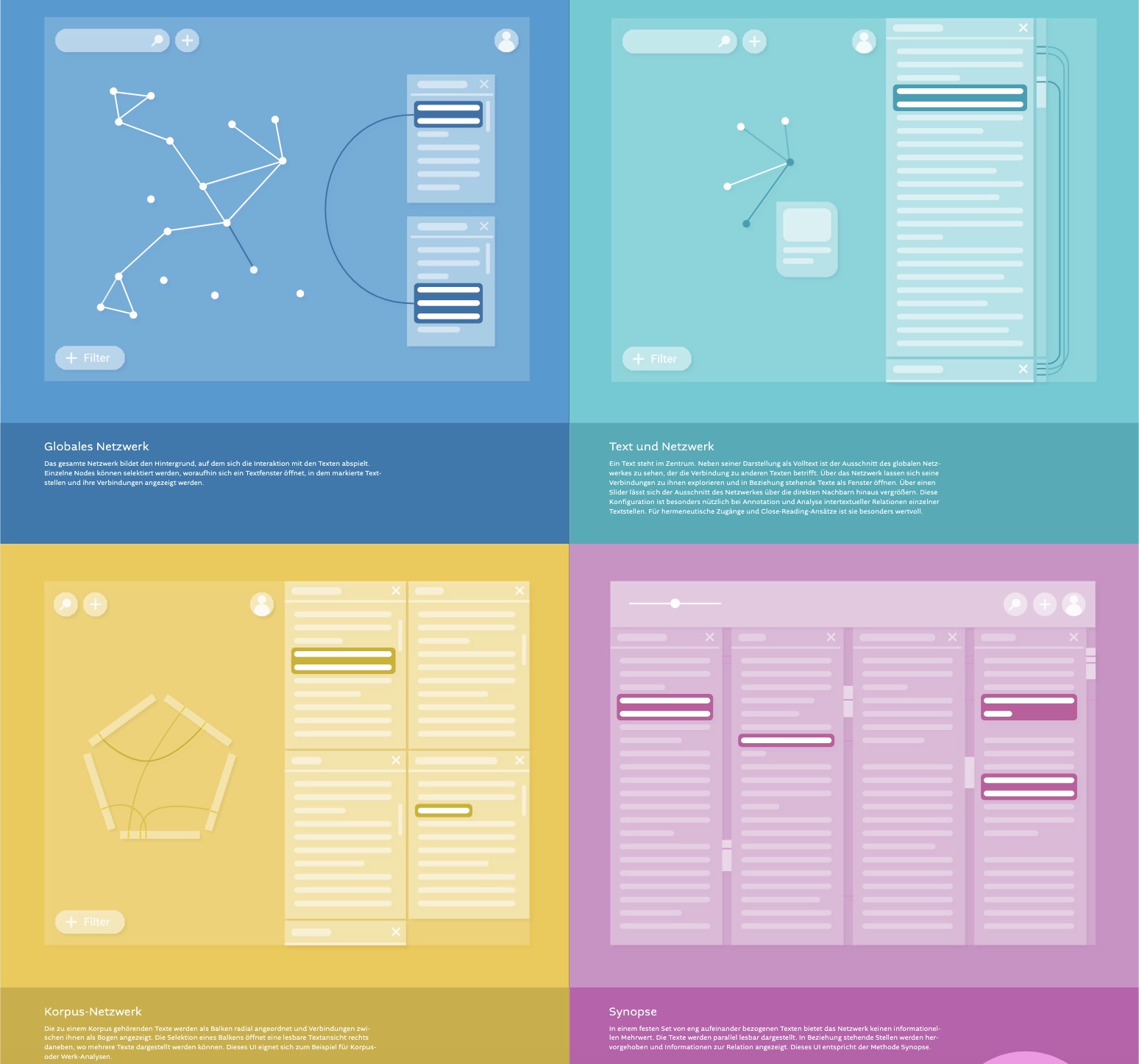
Our long-standing research into intertextuality has led to the concept of the ‘Intertextor’, which I am developing in collaboration with the SCDH in Münster and the HCDS at the University of Hamburg. Intertextor will be a tool that allows intertextual relationships to be annotated intuitively by hand. These relationships between texts are converted into a standard format (foundational ontologies such as CIDOC-CRM and specific intertextuality ontologies such as INTRO) that is readable by the Semantic Web, so that the distributed knowledge of intertextual relationships can be consolidated, visualised and analysed within a globally accessible knowledge network (knowledge graph). Information on the current development, publications, presentations, etc., can be found on GitHub: Intertextor.
Service Center for Digital Humanities (SCDH)
Digital Humanities (DH) is what everyone is talking about. It makes research possible that would otherwise not exist. In practice, however, good ideas often get stuck due to a lack of expertise in their implementation. Within the framework of the DH structure at Münster University, researchers therefore work together with IT developers on concrete solutions for ideas and projects and thus advance the digital transformation of academic practice.
I was the head of the SCDH from 2021 to 2025.

Research Association Marbach Weimar Wolfenbüttel (MWW)
The German Literature Archive Marbach, the Klassik Stiftung Weimar and the Herzog August Bibliothek Wolfenbüttel founded the MWW research association in 2013 on the recommendation of the German Science and Humanities Council. Research in MWW takes place within the framework of the Digital Humanities to develop new, model solutions for collection research and indexing.
From 2020 to 2021, I was the managing director of the research network and headed the Digital Lab based in Weimar.
forTEXT. Investigating Literature Digitally
The platform forTEXT offers beginner-friendly citable method descriptions, text collections and tools – from digitization to annotation to interpretation and visualization of literature. You will also find materials for self-learning and for teaching at university and school.
I coordinated the DFG-funded project from 2017 to 2020 at the University of Hamburg.

CATMA
CATMA stands for Computer Assisted Text Markup and Analysis. It is a browser-based tool that digitally supports the manual annotation and analysis (including visualization) of texts. CATMA is based on the traditional (hermeneutic-cyclical) philological workflow and can be used in a very low-threshold way – even collaboratively.
In the course of the forTEXT project, we released the sixth version of CATMA in 2019.

Renunciation and Irony in Goethe
In the discussion about the status of the Digital Humanities (DH) as a scholarly discipline, the possibility of reconnecting digital techniques, methods, and theories is often brought into the field. But how exactly can digital methods of textual analysis bridge the gap to more traditional literary studies? And conversely, how can theoretically complex literary concepts be explored digitally? Rabea Kleymann’s and my article uses the concrete example of “Renunciation and Irony in Goethe” to show how a combination of distant and close reading methods in the course of scalable reading can promote and connect discussions in Goethe research on the part of DH.
Jan Horstmann, Rabea Kleymann: “Alte Fragen, neue Methoden – Philologische und digitale Verfahren im Dialog. Ein Beitrag zum Forschungsdiskurs um Entsagung und Ironie bei Goethe”. In: Zeitschrift für digitale Geisteswissenschaften. Wolfenbüttel 2019. text/html Format. DOI: 10.17175/2019_007.
Theater Narratology
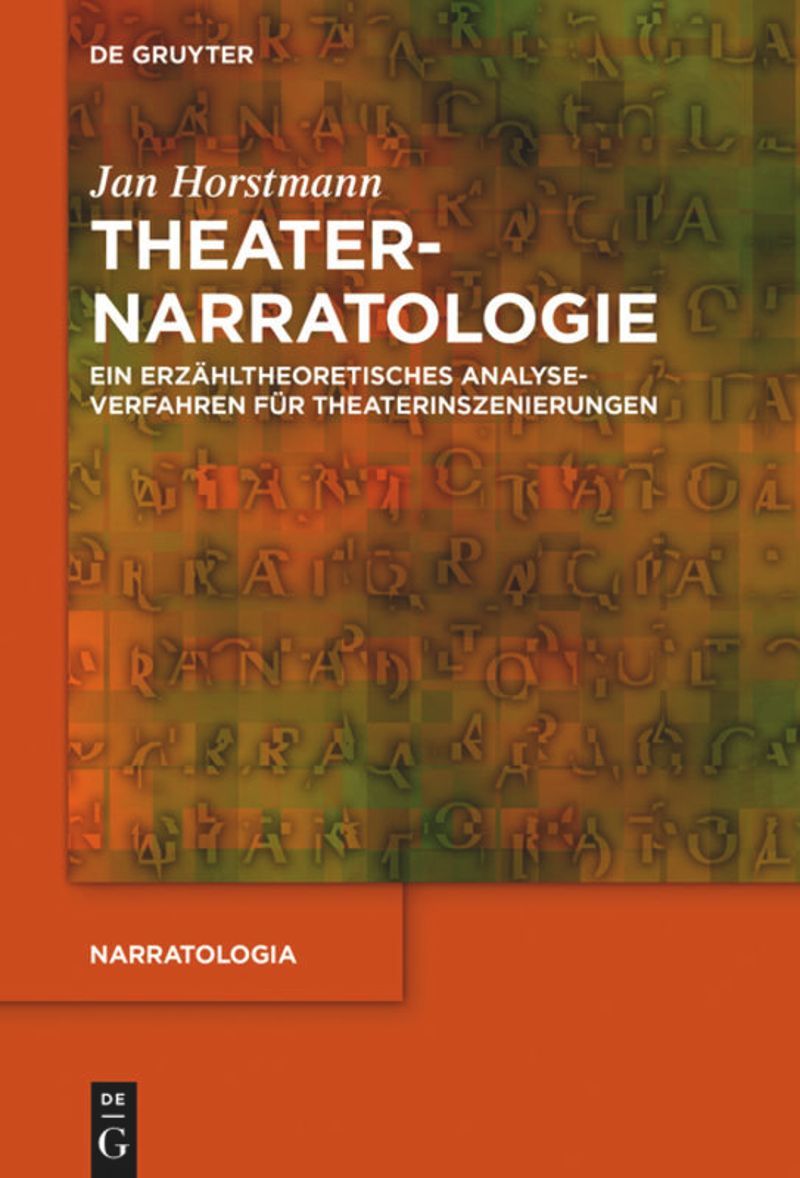
The narrative dimension has been underrepresented in theatrical performance analysis. In order to remedy this desideratum, my dissertation (2013 to 2017) does not examine passages narrated by characters in individual performances, but rather poses the question in general: How does theater narrate? Theater Narratology thus develops for the first time, on the basis of a comprehensive theoretical foundation in relation to the research fields of classical and post-classical narratology and theater studies, a heuristic model of analysis of performative narrative that is suitable for practical application in narrative-theoretical performance analysis. The analytical categories developed make it possible to describe theatrical narrative in an intersubjectively comprehensible way and to place it in narratological terms not only in intertheatrical but also in intermedial contexts. Performativity and narrativity are thought of together and not as opposites, giving the possibility of a rapprochement of theatrical and narratological research.
The book Theaternarratologie. Ein erzähltheoretisches Analyseverfahren für Theaterinszenierungen was published as volume 64 of the Narratologia series at de Gruyter. DOI: 10.1515/9783110597868.
Talks
- 05/2026 – „Digitale Transformation der Geisteswissenschaften am Beispiel UHH: Das Digital Humanities Lab und seine Partner“, Workshop „Digital Humanities” (programme) · Kiel University
- 05/2026 – Keynote: „Geisteswissenschaften digital transformieren mit Tutorials: das Projekt forTEXT“, QUADRIGA Jahrestagung 2026 (programme) · University of Potsdam
- 03/2026 – „Digital structures of collaboration in Humanities Research“, Exzellenz² – Einblicke, Erfahrungen, Entwicklungen (URL) · University of Hamburg
- 02/2026 – Panel Chair: „Epistemologie und Interpretation“, DHd conference 2026 (URL) · University of Vienna
- 02/2026 – „Not just Text, Intertext! Neue Wege der semantischen Modellierung und Annotation für intertextuelle Bezüge“, DHd conference 2026 (DOI) · University of Vienna
- 11/2025 — „Digital Humanities (DH) in der Lehre", Workshop Asia Africa Institute · University of Hamburg
- 03/2025 — „Alles hat seine Zeit: Generische Softwareentwicklung und individuelle Projektanforderungen", DHd conference 2025 (DOI) · University of Bielefeld
- 03/2025 — „Anno 2025. Das Annotationsspiel für große und kleine Forschende", poster slam DHd conference 2025 (DOI), awarded first place in the poster slam award · University of Bielefeld
- 04/2024 — „Intertextualität im Semantic Web. Eine Chance für die (Digitale) Literaturwissenschaft" · University of Vienna
- 02/2024 — „‘Roads? Where we’re going, we don’t need roads.’ Die Zukunft des Publizierens", poster slam DHd conference 2024 (DOI), awarded second place in the poster slam award · University of Passau
- 02/2024 — „Intertextor: Interfaces für die Annotation intertextueller Relationen", Posterslam DHd conference 2024 (DOI) · University of Passau
- 02/2024 — „Von Menschen und Maschinen: Transdisziplinäre Workflows im Münsteraner Editionsprojekt Heinrich Scholz", DHd conference 2024 (DOI) · University of Passau
- 01/2024 — „Produktive Reibungsflächen: Geisteswissenschaften und Datenvisualisierung", Coffee Lecture: Digital Humanities – wie geht das? (URL) · University of Hamburg
- 12/2023 — „Kollaboration als Notwendigkeit: Institutionelle Unterstützung für die Forschung in den Digital Humanities", DH Day 2023 (DOI) · University of Münster
- 11/2023 — „Digital Humanities an der Universität Münster" · University of Osnabrück
- 09/2023 — „Digital Humanities – Eine Brücke zwischen Geisteswissenschaften und Informatik", Podcast Neues aus der Alten Welt (URL) · University of Münster
- 07/2023 — „Collaboration as Necessity: Institutional Support for Digital Humanities Research", DH conference 2023 · University of Graz
- 06/2023 — „Collaboration as Necessity: Institutional Support for Digital Humanities Research", DH Colloquium · University of Cologne
- 03/2023 — „Textliche Relationen maschinenlesbar formalisieren: Systeme der Intertextualität", DHd conference 2023 (DOI) · University of Trier
- 03/2023 — „Grenzen der Offenheit: eine digitale Sammlung zur Erforschung historischer Arzneimittelrezepte", DHd conference 2023 (DOI) · University of Trier
- 01/2023 — „Visualisierungen kritisieren: Kriterien der Visual Literacy für die Digital Humanities", MKWie? Resilienz-Workshop · University of Freiburg
- 09/2022 — Keynote: „Digitale Tools in geisteswissenschaftlicher Forschung – Textanalyse, Interpretation und Visualisierung", conference Von Daten zu Wissen (programme) · HAB Wolfenbüttel
- 09/2022 — „Embedded Digital Humanities. Ein methodenbasierter Brückenbau zwischen nicht-digitalen und Digitalen Literaturwissenschaften" · LMU Munich
- 04/2022 — „Digital Humanities an der WWU", Galery talk University and State Library · University of Münster
- 03/2022 — „Druckst du noch? Visionen und Bastionen des (digitalen) Publizierens in den Geisteswissenschaften", panel discussion Digitales Publizieren und die Qualitätsfrage. Wege für Open Access in den Geisteswissenschaften · University of Duisburg-Essen
- 03/2022 — „Digital Humanities", eScience day 2022 (DOI) · University of Münster
- 03/2022 — „Medienübergreifende narratologische Analysekategorien: Didaktik der Erzähltheorie zwischen Schule und Wissenschaft", conference: Erzähltheorie(n) und Literaturunterricht · University of Münster
- 03/2022 — „Visualization and Visual Literacy in the Humanities", Community of Practice „Data Literacy" (DL) · University of Bielefeld
- 03/2022 — „Erinnern durch Vernetzen", panel discussion DHd conference 2022 · University of Potsdam
- 02/2022 — „Taxonomiebasierte Annotation und Semantic Web", workshop: Softwaregestützte Kategorienentwicklung in Praxis und Forschung (programme and abstract) · Technical University of Darmstadt
- 12/2021 — „Visualisierung und Modellierung von Netzwerken und Zeitlichkeit", Cluster of Excellence Temporal Communities – Doing Literature in a Global Perspective · Free University of Berlin
- 11/2021 — „Visualität, Visualisierung und Visual Literacy als Aufgabe der Geisteswissenschaften", Digital*Humanities im Gespräch (abstract and recording) · Free University of Berlin
- 08/2021 — „Digital Laboratory and Virtual Research Space", European Summer University in Digital Humanities Culture & Technology · University of Leipzig
- 05/2021 — „Visualisierung als Methode der (digitalen) Geisteswissenschaften" · University of Marburg
- 04/2021 — „An Introduction to Digital Humanities: Possibilities and Challenges" · University of Lisbon, Portugal
- 02/2020 — „Kollaborative Literaturwissenschaft – digitales Annotieren literarischer Texte als diskursive Aushandlung von Vermittlungs- und Verstehensprozessen" · University of Duisburg-Essen
- 11/2019 — „Literatur digital erforschen: Methoden und Tools der digitalen Literaturwissenschaft" · University of Bonn
- 11/2019 — „Digitale und traditionelle literaturwissenschaftliche Methoden im Dialog: Dissemination von theoretischem, methodischem und praktischem Wissen", DFG symposium · University of Lüneburg
- 11/2019 — „Erzähltheorie und Theater. Möglichkeiten der narratologischen Analyse von Inszenierungen", lecture series Travelling Concepts. Literary Theory beyond the Scope of Literary Studies · University of Münster
- 06/2019 — „Visualisierung als Mittler zwischen quantitativen und qualitativen Methoden der (digitalen) Literaturwissenschaft" · Humboldt University Berlin
- 05/2019 — „Visualisierungsformen für quantitative und qualitative Methoden in der digitalen Literaturwissenschaft", Visualisierung in (digitalen) Editionen · North Rhine-Westphalian Academy of Sciences and Arts Düsseldorf
- 03/2019 — „Social Media, YouTube und Co: Multimediale, multimodale und multicodierte Dissemination von Forschungsmethoden in forTEXT", DHd 2019 multimedial & multimodal · University of Frankfurt
- 02/2019 — „Undogmatisches literaturwissenschaftliches Annotieren mit CATMA: manuell, halb-automatisch und automatisiert", Annotationen in Edition und Forschung. Funktionsbestimmung, Differenzierung, Systematisierung · University of Wuppertal
- 02/2019 — „Textvisualisierung: Epistemik des Bildlichen im Digitalen", DFG symposium „Wovon sprechen wir, wenn wir von Digitalisierung sprechen? Gehalte und Revisionen zentraler Begriffe des Digitalen · University of Bayreuth
- 12/2018 — „A Scalable Reading Approach to Goethe’s Narrative Texts: Investigating Renunciation and Irony", EADH 2018 conference · Galway University, Ireland
- 10/2018 — „Making Digital Routines, Resources, and Tools forTEXT Accessible for Humanists", Teaching English in the Era of Digital Humanities: A Multi-Disciplinary Perspective · University of Frankfurt
- 07/2018 — „Digital Methods to Analyze Semantic Phenomena: A Scalable Reading Approach to Goethe’s Narrative Texts", Ocean Narratives workshop · Kiel University
- 07/2018 — „Trauma(tizing) Narrative: Abused Trust as Content and Formal Device in Hanya Yanagihara’s Novel A Little Life (2015)", Summer Course in Narrative Studies (SINS) · Aarhus University, Denmark
- 04/2018 — „The Cut in Multinarratives: Hanya Yanagihara’s A Little Life (2015)", Narrative conference 2018 · McGill University Montréal, Canada
- 02/2018 — „Digital vs. Humanities? Didaktische Aufbereitung digitaler Methoden für die klassischen Geisteswissenschaften im Projekt forTEXT", DHd conference 2018 · University of Cologne
- 12/2017 — „Von der Bedarfserhebung zur nutzerorientierten Konzeptentwicklung. Die Relevanz von Interfacedesign und Visualisierung im literaturwissenschaftlichen Interpretationsprozess", Potsdamer Arbeitstreffen zur digitalen Literaturwissenschaft No. 2 · University of Potsdam
- 09/2017 — „Narrative Representation and Fictionality in Performative Media", conference European Narratology Network · University of Prague
- 09/2017 — Panel Chair: „Drama, Theatre, and Audionarratology", conference European Narratology Network · University of Prague
- 08/2017 — „forTEXT – Study Literature Digitally", Summer Course in Narrative Studies (SINS) · Aarhus University, Denmark
- 10/2016 — „Theaternarratologie. Ein erzähltheoretisches Verfahren zur Analyse von Theaterinszenierungen", Erzähltheoretisches Kolloquium (ETK) · University of Hamburg
- 08/2016 — „Non-Mainstream Identity in 18th and 19th Century German Fiction. Narrating the Androgynous and Hermaphroditic", Summer Course in Narrative Studies (SINS) · Aarhus University, Denmark
- 02/2016 — „Theatre Narratology", winterschool Transmedial Narratology · Universit of Tübingen
- 10/2015 — „Narrativization of Known Events", conference Perspectives and Frontiers of Cognitive Narratology · University of Prague
- 08/2015 — „Theatre Narratology. A narratological method for analyzing stage performances", Summer Course in Narrative Studies (SINS) · Aarhus University, Denmark
- 11/2014 — „Das Visuelle als Teil der performativen Narration in Theaterinszenierungen", Visual Narratives – Cultural Identities · University of Hamburg
- 08/2014 — „Theatre Narratology. A narratological model for analyzing theatre performances", Summer Course in Narrative Studies (SINS) · Aarhus University, Denmark
- 08/2013 — „Theaternarratologie", workshop Sprache, Literatur, Medien · Kiel University
- 08/2013 — „Focalization in Theatre", Summer Course in Narrative Studies (SINS) · Aarhus University, Denmark
- 03/2013 — „Theatre Narratology. A Narratological Method for Analyzing Theatre Performances", 3. conference European Narratology Network · University of Paris
- 01/2012 — „Theaternarratologie. Theaterwissenschaftliche Relevanz narratologischer Kategorien", Erzähltheoretisches Kolloquium (ETK) · University of Hamburg